The quick answer
An engineering workshop counts as a higher hazard workplace in HSE guidance. With 5 to 50 people on site, the suggestion is at least one trained first aider (EFAW or FAW, depending on the injuries you could see). Over 50, it’s at least one FAW-trained first aider for every 50 people.
That’s the minimum on paper. In practice you need enough first aiders that one is always on site, through shifts, holidays and sickness, and that usually means more than the table says.
Why a workshop counts as higher hazard
The HSE splits workplaces into lower hazard (offices, shops, libraries) and higher hazard. Light engineering and assembly work, warehousing, and extensive work with dangerous machinery or sharp tools are all named in the higher hazard group. Most engineering workshops I go into sit firmly in that second group.
Here are the HSE’s suggested minimums for a higher hazard workplace:
| People on site | Suggested first aid cover |
|---|---|
| Fewer than 5 | At least one appointed person |
| 5 to 50 | At least one first aider trained in EFAW or FAW, depending on the injuries that could happen |
| More than 50 | At least one FAW-trained first aider for every 50 people (or part thereof) |
The HSE is clear that these are suggestions, not fixed rules. Your own first aid needs assessment decides the real number, and that’s what an inspector will ask to see. See the HSE’s first aid needs assessment guidance.
EFAW or FAW: which one does a workshop need?
Emergency First Aid at Work (EFAW) is one day. It covers what to do in the first few minutes: CPR and using a defibrillator, someone who’s unresponsive but breathing, choking, serious bleeding, shock and minor injuries.
First Aid at Work (FAW) is three days. It covers everything on EFAW, then adds the injuries and illnesses you’d want more cover for in a workshop: broken bones and spinal injuries, burns, eye injuries, chest injuries, poisoning, and major illnesses such as heart attack, stroke, diabetes and epilepsy.
As a rough guide:
- Small workshop, mostly hand tools and light assembly: EFAW is often enough, as long as there’s always someone trained on site.
- Heavy machinery, lifting, hot work or chemicals: I’d look hard at FAW for at least some of your first aiders.
- A mix: plenty of firms train most of the team in EFAW and have one or two FAW first aiders for the bigger stuff.
Your needs assessment should say which, and why. If you’re not sure, ask me and I’ll talk it through with you before you book anything.
Don’t forget shifts, holidays and sickness
This is where most workshops get caught out. The table tells you how many first aiders you need on site at any one time, not how many certificates you need in a drawer.
If you run two shifts, each one needs cover. If your only first aider is off for two weeks in August, who steps in? Ask yourself:
- Is there a trained first aider on site every hour you’re working, including early starts and overtime?
- What happens when they’re on holiday, off sick or out on a job?
- Do your people work away at customers’ sites?
- Can a first aider reach any part of the site quickly, including mezzanines and yards?
In my experience, the number that keeps you covered is usually one or two more than the minimum.
What a one-day EFAW course looks like in a workshop
Last Friday I ran Emergency First Aid at Work for ten people from an engineering team, on their own premises. It’s a good example of what the day actually involves.
We started with CPR and the defibrillator. I demonstrate first, then everyone gets on the manikins and does it properly: hands in the centre of the chest, pushing hard and fast, and knowing when to bring the defib in.
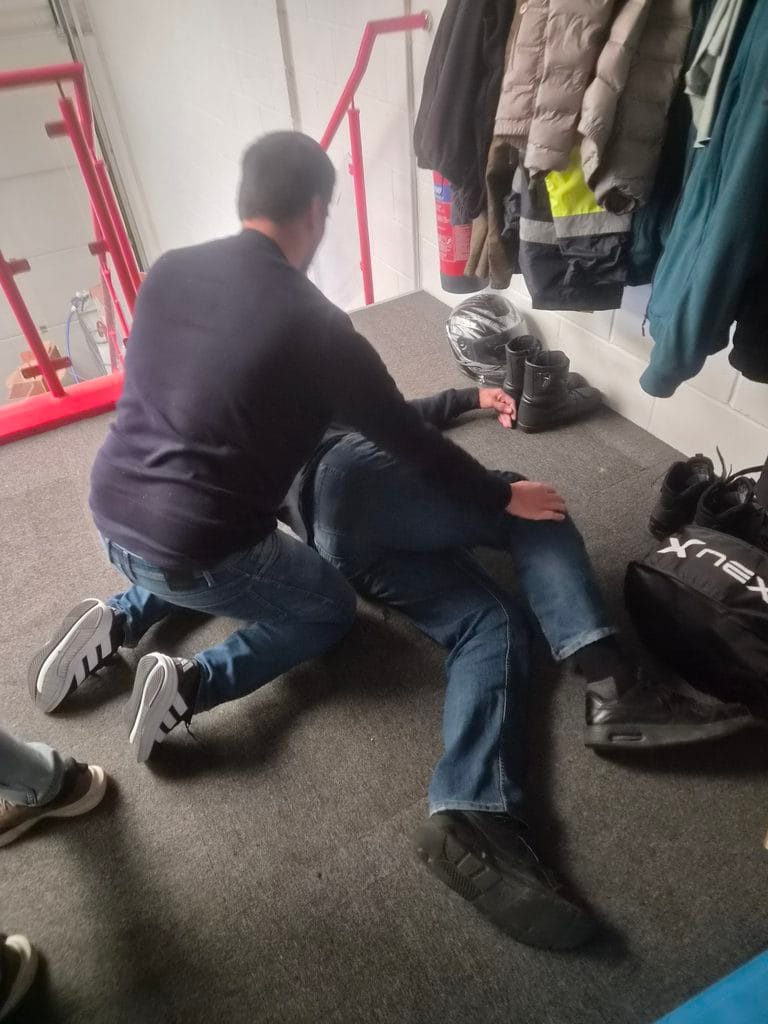
After that we did the recovery position, and everyone practised it on each other rather than just watching. That’s where you spot the small things. I had to correct one of the group partway through, which is exactly why hands-on practice matters.
Then choking. I wear a choking vest so people can practise abdominal thrusts for real and feel when they’ve done it right. We also covered bleeding, slings and minor injuries.
This team were brilliant. They got stuck in, asked a lot of questions, and there was plenty of laughter during the practicals. That’s usually a sign people will remember it.
One of the group, whose first language isn’t English, left this Google review afterwards, and it meant a lot:
“The instructor even if I’m not English and I don’t understand English 100%, explain me in a way to understand everything how to use in real life, a big thank you”
That’s what I aim for on every course. Everyone should leave knowing what to do for real, whatever their background.
Common questions
Is EFAW enough for an engineering company?
It can be for a smaller site with lower-risk work. If you use heavy machinery, lift heavy loads or work with heat or chemicals, your needs assessment may point you towards FAW for some of your first aiders.
How long does a first aid certificate last?
Three years for both EFAW and FAW. The HSE also strongly recommends a short annual refresher in between.
Can you train us at our own premises?
Yes. I train on site across Milton Keynes and the surrounding counties, and travel is included within 30 miles of Milton Keynes. If you can’t host it, I can find a venue nearby.
How many people can go on one course?
Up to 12 on a course.
Book training for your team
If you’re not sure how many first aiders your workshop needs, or whether it should be EFAW or FAW, give me a call on 0300 303 0724 or email hello@vitalsignsfirst.co.uk. You can see the course details and group prices on the Emergency First Aid at Work course page.